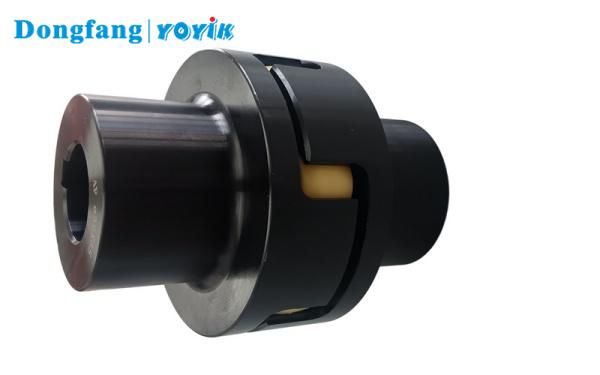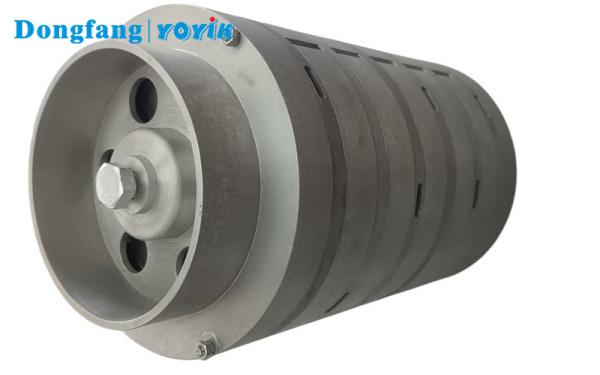
In the seal oil system of large turbine generator sets, differential pressure stability directly defines the safety margin of hydrogen-cooled generators. Deyang Dongfang Yili Electromechanical Equipment Co., Ltd. has long been engaged in the integrated optimization of core components for seal oil stations. It has found that the coupling of the HSND280-46N main seal oil pump is not merely a simple power transmission component, but a critical execution interface for closed-loop differential pressure control. This pump adopts a rigid diaphragm coupling design. Its axial stiffness and angular compensation accuracy together form the physical basis for the response characteristics of the differential pressure regulating valve. When the differential pressure between the air-side and hydrogen-side seal oil fluctuates at the millibar level, the micrometer-scale torque response delay of the coupling will directly affect the action sequence of the valve actuator. If the coupling coaxiality deviation exceeds 0.03 mm, the PID adjustment cycle of the differential pressure regulating valve will be extended by more than 12%, raising the risk of increased hydrogen leakage rate. This explains why under emergency conditions where the mechanical seal of the seal oil DC emergency oil pump fails, the HSND280-46N must form dual-source redundant linkage with the air-side DC seal oil pump. The former ensures the dynamic response of the main control loop through rigid coupling of the coupling, while the latter maintains the basic differential pressure backup via an independent drive circuit. As a core manufacturing base for major technical equipment in China, Deyang’s precision machining cluster provides process support for the coupling’s dynamic balance accuracy (Grade G1.0). This regional industrial advantage enables domestic alternative solutions to outperform some imported equivalents in terms of reliability.
System-wide Differential Pressure Stabilization Strategy: In-depth Coordination from Main Pump Coupling to Critical Spare Parts
Sustained stability of differential pressure relies not on a single component, but on systematic engineering covering the main bearing of the seal oil station, recirculation circuit and emergency support system. Serving as the physical reference surface for differential pressure generation, the main bearing of the seal oil station, with its surface roughness Ra ≤ 0.4 μm and the shaft runout of the HSND280-46N pump ≤ 0.02 mm, forms the precision chain for initial differential pressure generation. Within this chain, the coupling acts as a “precision gatekeeper”. It not only isolates the transmission of motor vibration to the main bearing, but also keeps the pump speed fluctuation within ±0.5%. Otherwise, the orifice plate in the recirculation pump minor repair kit will generate cavitation noise due to sudden flow changes, which may further trigger misjudgment by the differential pressure sensor. Field test data from Deyang Dongfang Yili Electromechanical Equipment Co., Ltd. shows that within 72 hours after replacing the recirculation pump minor repair kit, if the concentricity of the HSND280-46N coupling is not calibrated synchronously, the amplitude of differential pressure fluctuation increases by an average of 23%. This reveals a deep-seated logic overlooked by the industry: there exists a “precision transfer attenuation effect” in seal oil system maintenance, meaning minor deviations of upstream components will be amplified through multiple stages and impair the terminal control accuracy. When customers purchase the HSND280-46N coupling, they are actually acquiring the physical anchor point of a complete differential pressure stabilization solution. Three rigid indicators are included in the compatibility verification between this component and the main seal oil pump: coupling temperature rise ≤15 K under hot operation, transient axial displacement ≤0.05 mm during start-stop cycles, and zero detection rate of diaphragm fatigue cracks after 2000 hours of continuous operation. Behind these data lies Deyang Dongfang Yili’s thorough analysis of seal oil system failure modes. The company has implanted the failure probability model of the mechanical seal for seal oil DC emergency pump into the coupling design parameters, so that the redundancy under normal operating conditions can automatically cover the stress peak under accident conditions. For power plants undergoing seal oil station upgrading, selecting this coupling is not only a replacement of worn parts, but also the reconstruction of a reliable foundation for the differential pressure control system.
DFYLSYC-2026-11-20-A