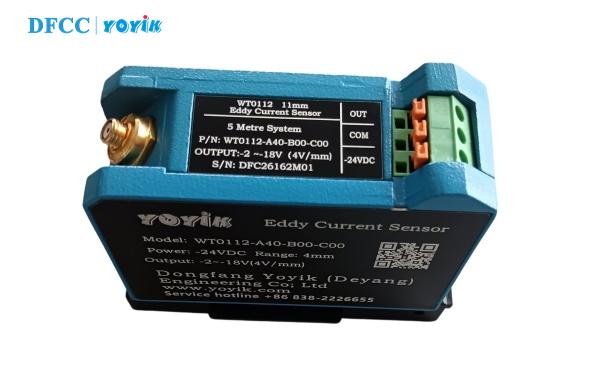
The 268.33.01.01 (3) is a differential transformer-type LVDT displacement sensor custom-engineered for large-scale thermal power plant steam turbines. Developed specifically for monitoring the stroke of hydraulic servomotors across multiple turbine cylinders, it is designed to suit the operating conditions of valve actuators for high-pressure (HP), intermediate-pressure (IP), and low-pressure (LP) cylinders. Utilizing non-contact measurement technology, the sensor features a compact structure and exceptional adaptability; it precisely captures real-time servomotor stroke and valve opening changes, converting mechanical displacement signals into stable standard electrical signals that are transmitted to the DEH control system for precise closed-loop regulation. Serving as a core sensing component for valve positioning, load stabilization, and safety interlocking, this model enables unified monitoring across multiple cylinders, simplifies spare parts management, and withstands harsh operating environments—such as high temperatures, intense vibration, and oil exposure—making it a standard, essential component for 300MW–1000MW class steam turbine systems.
Q: Where is the 268.33.01.01 (3) displacement sensor primarily installed on the turbine unit?
A: This sensor is designed specifically for monitoring steam turbine cylinders and is precisely adapted for actuator monitoring across different cylinders, with applications as follows:
HP Cylinder Servomotor: Monitors the full stroke of the Governor Valve (GV) actuator, providing foundational data for valve control and regulation.
IP Cylinder Servomotor: Captures real-time stroke parameters of the Intercept Valve (IV) actuator, meeting the unit’s dynamic load regulation requirements.
LP Cylinder Servomotor: Continuously feeds back actual valve opening values, ensuring precise and controllable valve positioning.
Q: What practical functions does the sensor perform when installed on different cylinders? A:
High-pressure cylinder operation: Precisely captures the actuator’s extension/retraction stroke; the integrated control system regulates the high-pressure valve’s opening/closing range, stabilizing the main steam supply.
Intermediate-pressure cylinder operation: Synchronously feeds back changes in mechanism travel, enabling the unit to flexibly adjust output based on electrical load and enhancing generation efficiency.
Low-pressure cylinder operation: Transmits real-time control valve opening data, preventing valve position deviation and maintaining the operational stability of the unit’s shafting and piping.
Q: What are the advantages of using the same sensor model across multiple cylinder types?
A:
High versatility: A single model covers monitoring scenarios for high-, intermediate-, and low-pressure cylinder servomotors, simplifying spare parts inventory management.
High data compatibility: Sensing parameters align with the operating characteristics of each cylinder; stroke feedback is accurate and free from deviation, integrating seamlessly with the unit’s existing control system.
Robust operational resilience: Withstands high-temperature environments and equipment vibration near the cylinders, ensuring excellent long-term monitoring stability.
Q: What are the key considerations for basic usage during on-site application?
A:
Installation alignment: Ensure the sensor is coaxial with the actuator’s direction of movement to minimize mechanical wear and measurement errors.
Range matching: Determine the installation position based on the maximum valve stroke for each cylinder to prevent component damage caused by over-travel.
Data verification: Regularly compare local valve positions with data displayed in the control system; calibrate and maintain the unit promptly if numerical anomalies occur.
Environmental protection: Implement dust and oil-proofing measures to prevent contaminants from interfering with sensor detection and extension/retraction movements.
DFYLSYC-2026-09-11-A